Distant Worlds – Elite Dangerous’ Space Tourism

Earlier this month, an ambitious tour of numerous, awe-inspiring sights was launched. This expedition is due to last 18 weeks, and has over 8,000 participants. It has been meticulously planned, with social events and meetups scheduled so those partaking can share and discuss their observations. It might not have captured the attention of the world because this tour is happening amongst the stars of Elite Dangerous – a massively multiplayer, open-world spaceflight sim. 

Distant Worlds 2 is an unofficial exploration tour which kicked off on January 13th, 2019. Players began their voyage in the Pallaeni system, and the tour will conclude upon arrival at a location named Beagle Point; some 65,000 light years later. The expedition’s mission statement is to take its thousands of participants – known as Commanders – on a journey of discovery. Distant Worlds 2 has garnered mainstream press coverage, with articles in Polygon and PC Gamer. Even NASA astronaut Chris Hadfield sent a message of encouragement to the Distant Worlds explorers.

The expedition itself is also embedded with social features often associated with going on a tour. Whilst participants are able to travel the planned route at their own pace, designated waypoints have been set allowing players in groups and solo explorers to rendezvous each weekend. Distant Worlds 2 describes its ethos as one of “freedom and diversity,” supported by a framework of social inclusion – these ‘Waypoint Weekends’ will therefore feature games, events and competitions along the way.

Whilst I’m not one of the adventurous trailblazers presently en route to Beagle Point, I am currently in the midst of an Elite Dangerous binge. It’s a game I play in spurts, because it takes me a very long time to accomplish very little. At least, it does the way I play it, which is part of the pleasure I derive from my time amongst its stars. The game is ostensibly based around four central pursuits: mining, trading, combat and exploration. However, beyond these pillars there is very little structure to guide players. Instead, developer Frontier effectively leaves it to the individual to decide how they want to interact with the game’s universe. There is an overarching narrative that guides major in-game developments, be it around the political powers operating therein or the presence of an alien threat. However, this largely sits in the background – I prefer to set myself a goal, get halfway there and become distracted with another pursuit that catches my eye on the way.

However, what makes Elite Dangerous such an interesting subject to write about through the lens of game tourism are the ways in which its player base has created social traditions around the concepts of travel, exploration and sight-seeing outside of the game’s in-built progression structure and narrative (such as it is). This truly is an example of democratic exploration and social expansion, one in which players can participate, or simply observe as interested bystanders gazing across the stars.

The Elite Dangerous subreddit regularly features posts from players who have made a journey to distant destinations known for their beauty. Exploration by way of tourism has also become a legitimate way of progression in the game itself – credits (in-game money) are awarded for data collected by visiting star systems, and players can pick up missions at orbital stations in which they are tasked with ferrying passengers on sight-seeing trips across the galaxy.

Around a year ago, a group of players formed The Galactic Travel Agency (TGTA) with a view to providing players with their own in-game “sightseeing service” – distinct from the game’s set missions and for players themselves. The TGTA is a self-proclaimed non-profit organisation – whilst it has broadened its outreach efforts to include mining and trading activities, its current collaboration with Distant Worlds 2 demonstrates the Agency’s continued commitment to “democractize exploration.” Players can work with the Agency as tour guides during the Distant Worlds expedition, deriving a sense of accomplishment through the pursuit of showing others “the wonderful waypoints, awe-inspiring sights and great communities of the expedition.”

In his book Tourism: Rethinking the Social Science of Mobility, Colin Michael Hall focuses on mobility as a concept through which tourism might be defined and understood. His research seeks to place the study of tourism within the context of a “wider economic, political, and social environment within which the phenomenon of tourism mobility occurs.” In this sense, one might characterise the player appropriation of exploration in Elite Dangerous – with its emphasis on freedom, diversity and community – as an act of democratising mobility itself. It serves to remove in-game constraints such as skill, experience and expense, providing all commanders with access to the wonders of the stars. Per ardua ad astra, indeed.

_________

You can follow the Distant Worlds 2 expedition schedule here.

Hall, Colin Michael. Tourism: Rethinking the Social Science of Mobility. Harlow: Pearson Education Limited, 2005
What is Game Tourism?

As this is the first post filed under Wanderlust: Game Tourism, I thought it would be appropriate to explore ‘game tourism’ as a concept. So, to dive right in: what does game tourism actually mean? I choose to define game tourism as a mode of in-game exploration and movement that typically eschews narrative or objective-based progress. Instead, game tourism prioritises a sense of immersion in setting, via the acute observation of landscape, aesthetic and ambience. However, game tourism might also serve to encourage players to consider how environment works to embody and evoke wider thematic concerns at the heart of a particular game.

Writing for AV Club, Alexander Chatziioannou cites The Witcher 3 and Dark Souls as two games which have compelled him to slow down his game play in order to become more immersed in the setting of each. Chatziioannou describes The Witcher 3’s “greatest pleasure” as exploring its “stunning environments and taking in a seemingly endless procession of breath-taking vistas.” He argues:

“The watery drakkar graveyard populated by a flock of lamias lazily diving into the icy depths of the Skellige archipelago or the sun setting over a Toussaint vineyard and blasting the sky with every perceivable hue of red and purple—those are sights that cannot be fully absorbed in a second. They demand to be lingered on, meticulously framed and slowly savoured.”

I would suggest there are a lot of games which lend themselves to this ritual. In No Man’s Sky and Elite Dangerous, players jump into a ship and are immediately afforded seemingly limitless freedom to explore the universe (which is visually conceived very differently in each title). Firewatch and Everybody’s Gone to the Rapture, two games that have been tagged as belonging to the sub-genre of ‘walking simulators,’ are also acutely evocative of exploration and tourism. Both have been lauded for their stunning, yet wholly distinctive visual styles in rendering their respective in-game environments. From the vast expanse of space to an idyllic English village exist a myriad of games which stimulate the practice of exploring and observing landscape, setting and aesthetic. I also fully intend to discuss the intersection of genre and game tourism as it pertains to individual titles, in future posts. The concept of ‘walking simulators,’ for example, has generated plenty of discussion around definition – there’s also been some controversy as to whether games in this genre even deserve to be called ‘games,’ in the traditional sense. And what does traditional even mean in an industry that continues to experience rapid technological development? The space to unpick and explore such debates is one reason why I started Digital Reprise.

To get back on topic…it’s worth acknowledging the fact that Firewatch and Everybody’s Gone to the Rapture are also played in the first person; whilst placing players within an environment in which they are actively encouraged to wander. The utilisation of first-person perspective also lends itself to what I described above as game tourism’s ability to push the player to consider how the landscape which they roam can still play an important role in relation to character and narrative. Chatziioannou provides a great example of this when he argues that “Dark Souls hero is an empty cipher for the player to fill.” This lack of personality or character might therefore drive some players to “active projection,” described as:

“an attempt to further immerse yourself in a game by embodying a specific character in a particular way, [which] may be a more powerful factor in sticking to sauntering than either compulsion or the joys of virtual sightseeing.”

Whilst compulsion still places the onus on the player to proactively engage with setting in order to derive personal benefit from such an approach, it nevertheless presents an interesting perspective to what game tourism can be for different players in a particular game.

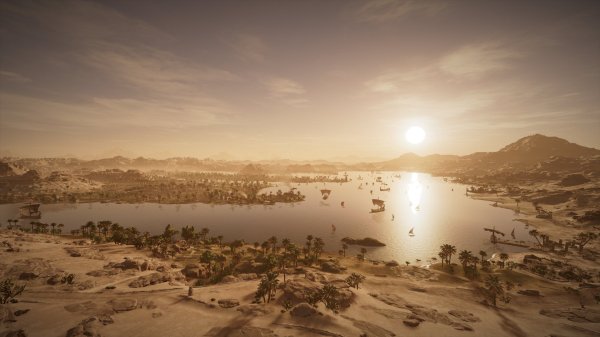
And so, to end this post, I’d like to talk about Assassin’s Creed – a franchise that is oft-cited for its eye-catching presentation of setting and landscape. Each title places the player in a delicately recreated historic era, ranging from the Italian Renaissance to Ptolemaic Egypt. Recent entries in the series have included the welcome addition of a photo mode, enabling game tourists to capture moments and vistas and edit them mid-game. I can’t get enough of it.

I’m currently making my way through ancient Greece during the Peloponnesian War, as I play through Assassin’s Creed Odyssey. However, in 2018, Ubisoft introduced a Discovery Mode to that game’s predecessor: Assassin’s Creed Origins. Ubisoft describes this mode as one which enables players to explore the space of ancient Egypt “without being interrupted by combat or quests.” Instead, Discovery Mode is regarded as an educational experience; a “virtual museum” that offers guided tours of historical sites. Perhaps this, then, is the next evolution of in-game exploration and observation: a curation of moments; another way to experience setting that fosters learning, understanding and enjoyment distinct from core gameplay objectives.

_________

You can read Alexander Chatziioannou’s article ‘Walk, don’t run: When moving slowly makes games better,’ here.

Blog at WordPress.com.

Up ↑