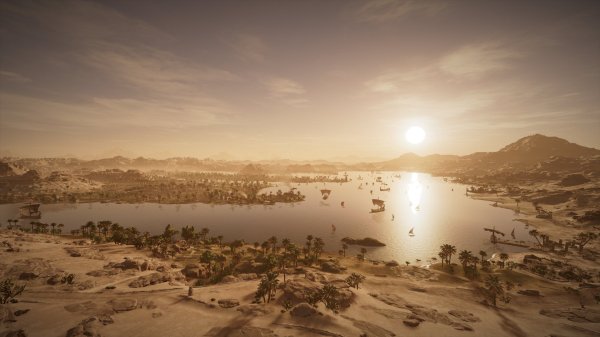
As this is the first post filed under Wanderlust: Game Tourism, I thought it would be appropriate to explore ‘game tourism’ as a concept. So, to dive right in: what does game tourism actually mean? I choose to define game tourism as a mode of in-game exploration and movement that typically eschews narrative or objective-based progress. Instead, game tourism prioritises a sense of immersion in setting, via the acute observation of landscape, aesthetic and ambience. However, game tourism might also serve to encourage players to consider how environment works to embody and evoke wider thematic concerns at the heart of a particular game.
Writing for AV Club, Alexander Chatziioannou cites The Witcher 3 and Dark Souls as two games which have compelled him to slow down his game play in order to become more immersed in the setting of each. Chatziioannou describes The Witcher 3’s “greatest pleasure” as exploring its “stunning environments and taking in a seemingly endless procession of breath-taking vistas.” He argues:
“The watery drakkar graveyard populated by a flock of lamias lazily diving into the icy depths of the Skellige archipelago or the sun setting over a Toussaint vineyard and blasting the sky with every perceivable hue of red and purple—those are sights that cannot be fully absorbed in a second. They demand to be lingered on, meticulously framed and slowly savoured.”
I would suggest there are a lot of games which lend themselves to this ritual. In No Man’s Sky and Elite Dangerous, players jump into a ship and are immediately afforded seemingly limitless freedom to explore the universe (which is visually conceived very differently in each title). Firewatch and Everybody’s Gone to the Rapture, two games that have been tagged as belonging to the sub-genre of ‘walking simulators,’ are also acutely evocative of exploration and tourism. Both have been lauded for their stunning, yet wholly distinctive visual styles in rendering their respective in-game environments. From the vast expanse of space to an idyllic English village exist a myriad of games which stimulate the practice of exploring and observing landscape, setting and aesthetic. I also fully intend to discuss the intersection of genre and game tourism as it pertains to individual titles, in future posts. The concept of ‘walking simulators,’ for example, has generated plenty of discussion around definition – there’s also been some controversy as to whether games in this genre even deserve to be called ‘games,’ in the traditional sense. And what does traditional even mean in an industry that continues to experience rapid technological development? The space to unpick and explore such debates is one reason why I started Digital Reprise.
To get back on topic…it’s worth acknowledging the fact that Firewatch and Everybody’s Gone to the Rapture are also played in the first person; whilst placing players within an environment in which they are actively encouraged to wander. The utilisation of first-person perspective also lends itself to what I described above as game tourism’s ability to push the player to consider how the landscape which they roam can still play an important role in relation to character and narrative. Chatziioannou provides a great example of this when he argues that “Dark Souls’ hero is an empty cipher for the player to fill.” This lack of personality or character might therefore drive some players to “active projection,” described as:
“an attempt to further immerse yourself in a game by embodying a specific character in a particular way, [which] may be a more powerful factor in sticking to sauntering than either compulsion or the joys of virtual sightseeing.”
Whilst compulsion still places the onus on the player to proactively engage with setting in order to derive personal benefit from such an approach, it nevertheless presents an interesting perspective to what game tourism can be for different players in a particular game.

And so, to end this post, I’d like to talk about Assassin’s Creed – a franchise that is oft-cited for its eye-catching presentation of setting and landscape. Each title places the player in a delicately recreated historic era, ranging from the Italian Renaissance to Ptolemaic Egypt. Recent entries in the series have included the welcome addition of a photo mode, enabling game tourists to capture moments and vistas and edit them mid-game. I can’t get enough of it.
I’m currently making my way through ancient Greece during the Peloponnesian War, as I play through Assassin’s Creed Odyssey. However, in 2018, Ubisoft introduced a Discovery Mode to that game’s predecessor: Assassin’s Creed Origins. Ubisoft describes this mode as one which enables players to explore the space of ancient Egypt “without being interrupted by combat or quests.” Instead, Discovery Mode is regarded as an educational experience; a “virtual museum” that offers guided tours of historical sites. Perhaps this, then, is the next evolution of in-game exploration and observation: a curation of moments; another way to experience setting that fosters learning, understanding and enjoyment distinct from core gameplay objectives.
_________
You can read Alexander Chatziioannou’s article ‘Walk, don’t run: When moving slowly makes games better,’ here.
 DigitalReprise